







When Pierre Boulle’s 1963 novel La Planète des singes was optioned for film by producer Arthur P. Jacobs, it must have been difficult to imagine that the movie, which finally arrived five years later as Planet of the Apes, would ever reach the screen at all. Science fiction was still largely considered B-movie material, and no studio in Hollywood was willing to accept Jacobs’ pitch about a movie set in a civilization of talking apes. Yet the 1968 film became an enduring sci-fi classic—but not without significant changes that made it possible to bring Boulle’s story to life.
Strangely enough, once Planet of the Apes officially became a multi-film saga and sequels were churned once a year between 1970 and 1973, it was one of those entries—1971’s Escape from the Planet of the Apes—that ended up returning unexpectedly to many aspects of Boulle’s original vision. Escape also became the most acclaimed of the four initial sequels, second only to the original itself, and remains a fan favorite to this day.
Boulle’s novel opens with a husband-and-wife pair of astronauts enjoying an interstellar cruise when they come upon a bottle floating in space. The literal message in a bottle is a manuscript penned by a journalist, Ulysse Mérou, who relates how he undertook a voyage to the star Betelgeuse with two scientists, with time dilation causing just two years to pass on the ship while centuries zoom by outside. Upon landing on a planet that they name Soror, the three men find themselves among a tribe of mute “savages” who appear to be more or less human. The tribe is attacked by gorillas on horseback wielding weapons; one of Mérou’s companions is killed, while Mérou himself is captured and brought to a modern city.
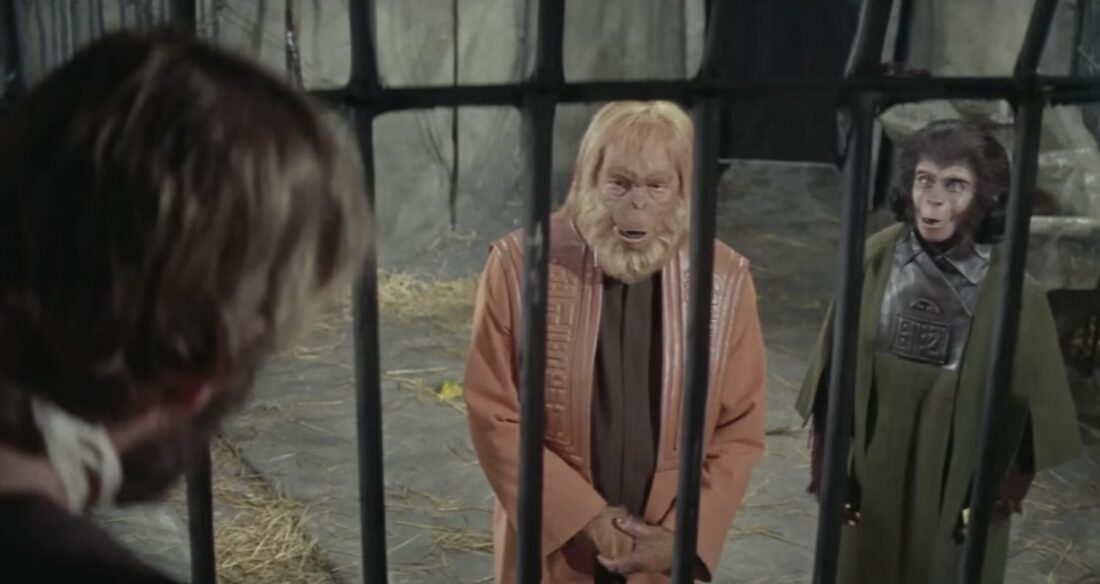
It soon becomes evident that on Soror, apes are the dominant, intelligent species, while humans are considered little more than animals. But when Mérou makes it clear that he is intelligent and can speak, a chimpanzee scientist named Zira takes an intense interest in him. Mérou is eventually accepted by ape society, allowed to live in comfortable surroundings and given clothing, and even speaks before an assembly of apes.
Meanwhile, Zira’s archaeologist fiancé, Cornelius, discovers incontrovertible evidence that there was once a human civilization on Soror that was eventually overthrown by the simians. At the same time, Mérou learns that Nova, the Sororian woman he has mated with, is pregnant—and since the baby will be the first offspring born of an intelligent human in centuries, the new family represents an existential threat to an ape society that now in all likelihood will seek their extermination (Nova was also pregnant in an early draft of the Planet of the Apes script).
While La Planète des singes reads more like a Swiftian satire than the sci-fi action film that it spawned, Planet of the Apes does retain the spine and some of the tone of the book. The French journalist Mérou becomes a misanthropic American astronaut named Taylor (played by Charlton Heston), but Zira, Cornelius, and Dr. Zaius (in both the book and movie, a powerful orangutan official who wants to suppress all knowledge of humanity’s past) all make the transition from page to screen relatively intact (played by Kim Hunter, Roddy McDowall, and Maurice Evans respectively), as does the idea that the ape society was preceded by a human one whose downfall led to the ascendance of its simian cousins.
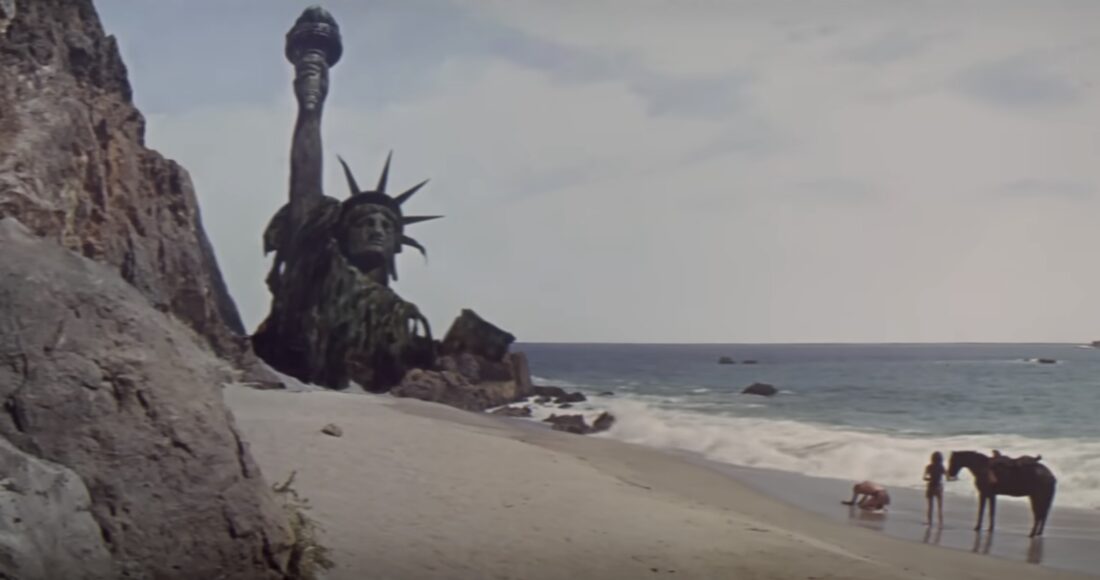
But one of the biggest changes from the book is the now legendary ending. Confronted with a ruined Statue of Liberty in the wasteland the apes call “the Forbidden Zone,” Taylor realizes he’s back on Earth, 2,000 years after humankind has destroyed itself in a nuclear holocaust. In the book, Mérou, Nova, and their baby son actually make it back to Earth, also millennia later, where—just like on Soror—humanity has fallen and apes are in control (a somewhat muddled version of this turned up in Tim Burton’s 2001 Planet of the Apes remake).
Twilight Zone creator Rod Serling, one of two credited screenwriters (along with Michael G. Wilson) on Planet of the Apes, is largely attributed with conceiving that haunting final image of Lady Liberty. But an almost equally significant change occurred after Serling handed the writing duties off to Wilson. Serling’s original script followed Boulle’s version of a contemporary ape society, with teeming cities, automobiles, fashionable clothing, aircraft, and many modern technological advancements, adjusted for anthropoid use. The apes wear suits, ties, dresses, and other human-like clothing, unlike the more uniform outfits seen in the film.
Serling estimated that shooting the movie that way would cost “a hundred million dollars,” telling Cinefantastique magazine in 1972, “It was an altogether 20th-century technology, a New York City in which the doors and automobiles were lower and wider… but of course that was much too expensive to do.” Indeed, it would have been no mean feat at a time when the film’s first proposed budget of $7 million got a firm “pass” from Warner Bros. Pictures (20th Century Fox ultimately bankrolled the movie for $5 million, with the budget going $800K over).
It was Michael G. Wilson who came up with the idea of the apes living in a rural, agrarian society. Advancements like rifles and primitive cameras are present, but the apes’ homes are made out of stone and nestled on hillsides, while transportation is by horseback or carriage. This not only eliminated the budgetary issue of creating a modern society for the monkeys, but also positioned their civilization as somewhat timeless, making it more difficult for Taylor (and the audience) to ascertain where he really was.
Many of the ideas that were excised from the final script for Planet of the Apes—outsiders finding themselves in advanced societies where they are considered barbaric until deemed otherwise, those same outsiders later being perceived as a threat to the current order, a pregnancy as the catalyst—eventually found their way into Escape from the Planet of the Apes three years later, but only after the massive success of the first film spawned a sequel that put the filmmakers in a creative corner.
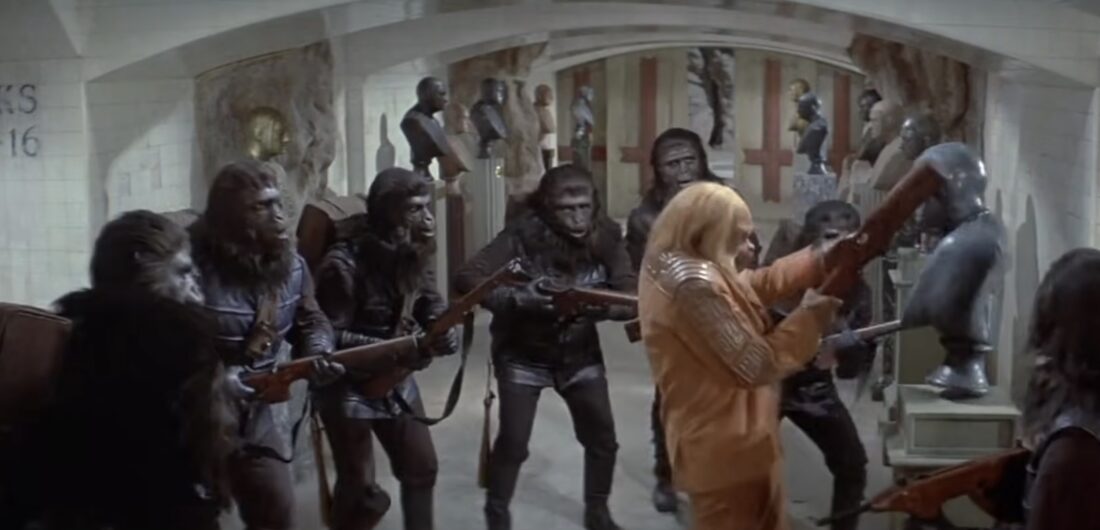
1970’s Beneath the Planet of the Apes finds Taylor, Nova, and another astronaut named Brent (James Franciscus) caught in a war between the militaristic gorillas who have come to power in the ape society and mutated, telepathic humans who live underground in the nearby ruins of New York City. With Fox insisting that the series end with this film, the climax has Taylor detonate a powerful weapon, worshiped by the mutants, that can and does destroy the entire world. And that was seemingly that—until Beneath became an improbable box office hit and screenwriter Paul Dehn famously received a telegram that read, “Apes exist. Sequel required.”
Dehn’s solution was not only a clever conceit that turned the Apes franchise into a full-blown futuristic saga, but managed to channel some of the original intent and vision of Boulle’s book. Escape from the Planet of the Apes has Cornelius (McDowall), Zira (Hunter) and a third chimp named Dr. Milo (Sal Mineo) salvage, repair, and launch Taylor’s original spacecraft just before the Earth is destroyed. The shockwave sends them hurtling back through time to our present, where the world is initially stunned and aghast to learn that they are intelligent beings from our own future (early drafts had the “ape-o-nauts” actually landing on a different, Earth-like planet with a human civilization like ours, until it was changed to Earth itself).
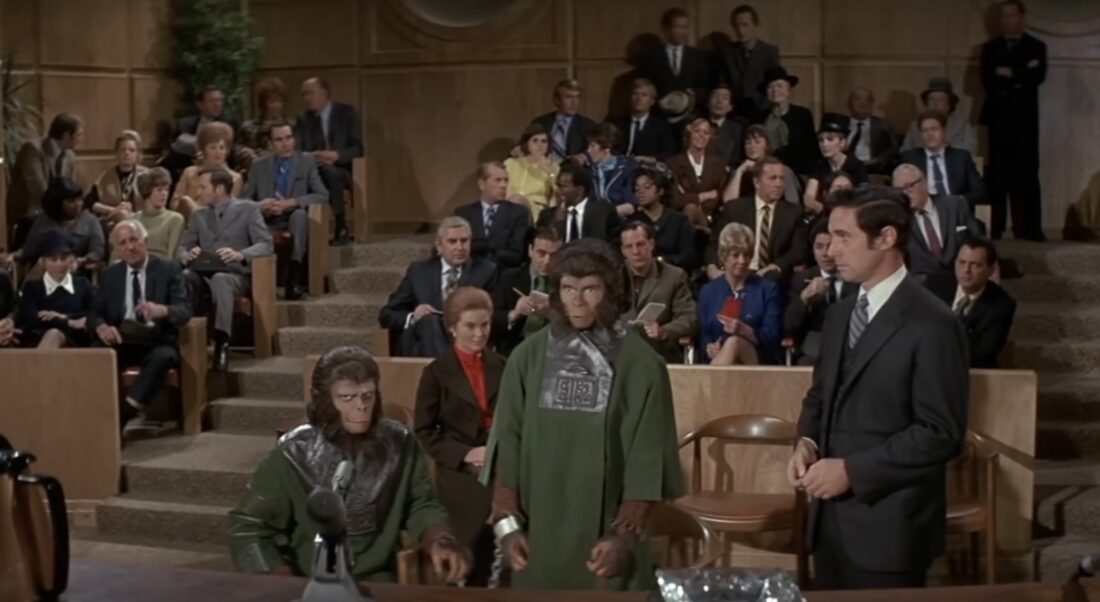
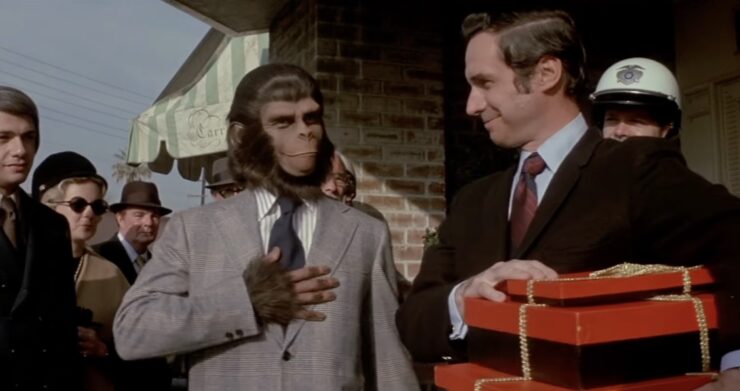
Milo is killed early on in an accident, but Cornelius and Zira—never more charming and likable than in this film—are soon treated as celebrities, taken shopping for clothes on Rodeo Drive and moved from their initial quarters at the Los Angeles Zoo to a suite at the Beverly Wilshire Hotel. Cornelius is treated as an esteemed historian, Zira is invited to speak to feminist organizations, and both become genuinely popular luminaries.
But then it’s revealed that Zira is pregnant, with the president’s paranoid science advisor, Dr. Otto Hasslein (Eric Braeden), also coaxing the knowledge out of her that the Earth will be destroyed in a war between apes and humans. The two chimps become for all intents and purposes enemies of the state, with Hasslein deducing that their intelligent progeny could in fact be the starting point for the evolutionary pivot that has apes ascend over humans. Zira and Cornelius are violently murdered in the movie’s shocking climax, but their baby survives, paving the way for the next two sequels.
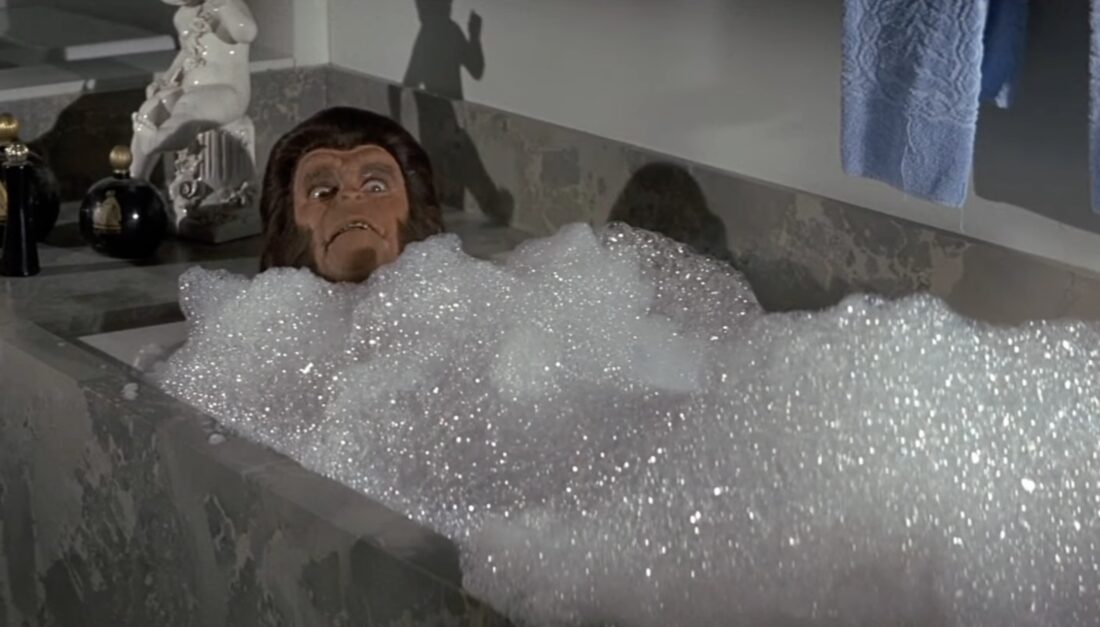
Escape from the Planet of the Apes cost $2 million to make—nearly two-thirds less than the original film—thanks to the fact that there were only three actors in ape makeup, and that a number of real locations in Los Angeles were used (even a primitive ape village cost money to build). Yet as a result, Escape gives us a sense of what a live-action Planet of the Apes truer to Pierre Boulle’s setting might have looked like. (The short-lived 1975 animated series Return to the Planet of the Apes was set in a technologically advanced ape society—the format not having the same financial restrictions—but it only lasted for 13 episodes and was hampered by the typically poor animation of many Saturday morning cartoon shows of the time.)
In Escape, the visitors out of space and time do not find themselves in a rural cliffside village, but a modern metropolis in which the humans they once saw as little more than brutes are now running the world. Writer Paul Dehn even consulted Boulle about inserting more satirical elements: The idea of seeing apes dressed in human clothing—one of the reasons why the first movie was stuck in development for so long—is turned on its head here as Cornelius and Zira go out shopping. The initial impulse on seeing them is perhaps to giggle (the fear of studio executives hesitant to greenlight the original film), but Roddy McDowall and Kim Hunter are so endearing, their reactions so amusing, that the sequence works. In another scene, Cornelius—ostensibly an animal to the people around him—is appalled by the violence as he watches a prize fight, while the supposedly “civilized” humans around him cheer and shout.
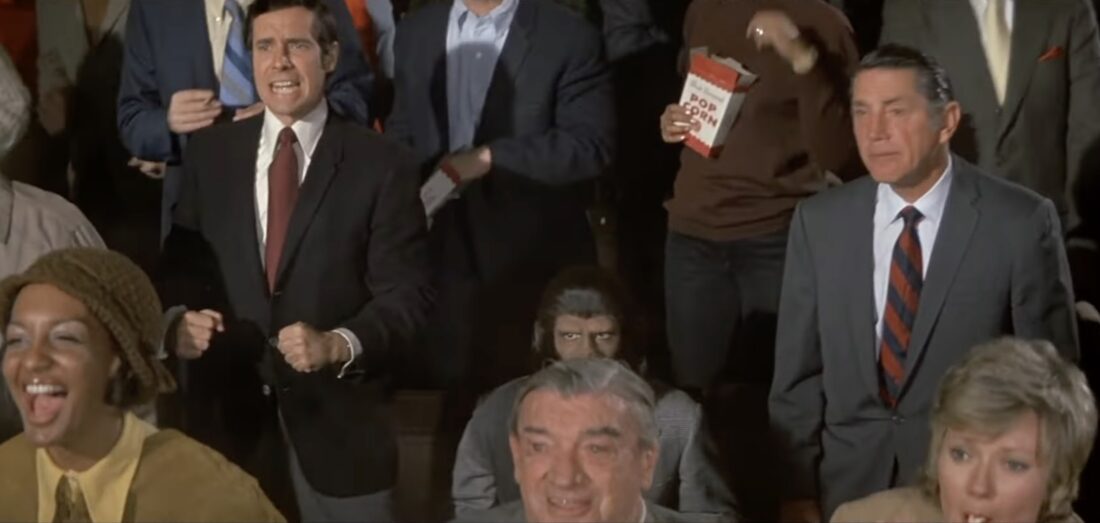
Charlton Heston’s Taylor is never embraced as a celebrity by the simian society in the Planet of the Apes film, although Mérou is heralded as such in the novel—until he’s perceived as a danger, that is. This is exactly what happens in Escape: Dr. Hasslein decides that the apes and their child must be terminated to save humanity. The notion of how rapidly we can turn on people whom we hold up as equals or cultural figures is mocked here with a few deft strokes. Cornelius and Zira find themselves ousted from the Beverly Wilshire and sent to a military camp; just like Mérou in the original novel, society quickly wants nothing to do with them. Unlike Mérou (and Taylor, at least initially), they are fated to be gunned down in cold blood… although the apes ultimately have the last laugh.
Even with its humor, modern setting, and satirical elements pushed to the fore, Escape from the Planet of the Apes wouldn’t live up to its title unless it had the kind of downbeat ending that the series became known for, and that even Boulle himself managed to convey in his own sardonic way (the astronauts that find Mérou’s manuscript? They’re chimps too, and they dismiss the whole thing as a fantasy story). Yet Escape also offers something else—a funhouse mirror glimpse of how a rigorously faithful live-action adaptation of the source text might have looked.
Sources
- Planet of the Apes Revisited by Joe Russo and Larry Landsman with Edward Gross
- Cinefantastique #6 (Summer 1972)
- Planet of the Apes: The Evolution of the Legend by Joe Fordham and Jeff Bond
- “The Secret Behind Escape” mini-documentary on the Escape Blu-ray
